Farsoon Metal 3D Printing Empowers China's Pinglu Canal Mega Project Construction
The Pinglu Canal, a major national water conservancy project in China, officially opens to navigation today. Recently, a CCTV documentary covered the R&D journey behind this century project, where one specific detail caught our attention—
The research team led by Professor Chen Yun from Wuhan University of Technology, responsible for the hydraulic fast hoist system of the canal lock valves, utilized Farsoon's 3D printing technology to manufacture the "labyrinth-type buffer sleeve," a critical component for the lock cylinder.
This represents a milestone application of metal additive manufacturing in the high-end equipment sector of China's water conservancy engineering.

The Pinglu Canal Madao Hub After Water Inflow (Source: Guangming Daily)
Core Component Manufacturing Challenges in a Mega-Project
According to CCTV, the construction of the Pinglu Canal faced extreme, unprecedented challenges with no established standards to follow, marking it as an entirely new national mega-project.
One of the design requirements was to increase the opening and closing speed of the water-saving basin valves, specified at four times the speed of conventional valves.
The valve opening and closing velocity directly impacts the valve's high-inertia load. From an industrial design perspective, increasing the hydraulic cylinder pressure allows the hoist to operate faster.
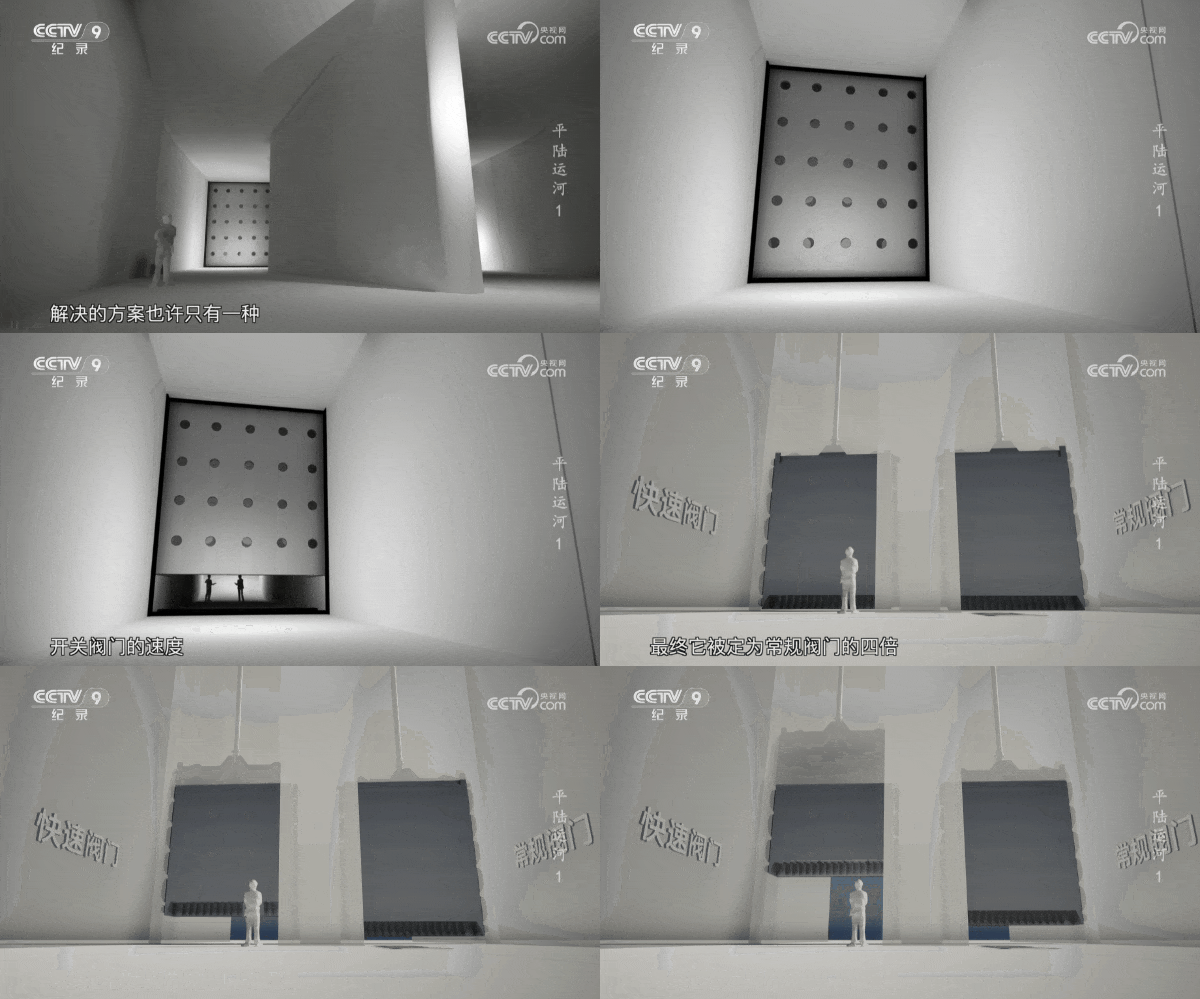
Animation Demonstration from CCTV-9 Documentary "Pinglu Canal"
However, the massive valves of the Pinglu Canal weigh up to 59 tons. During the final 30 cm stroke of descent, they impact the valve's metal frame structure at speeds far exceeding conventional norms, generating impact forces capable of tearing the surrounding concrete structure. Such impacts will occur more than 20 times per day during future lock operations.
Professor Chen Yun pointed out that existing valves could not meet these application requirements and proposed a novel design concept: integrating flow channels inside the valve buffer sleeve to provide cushioning via fluid dynamics.
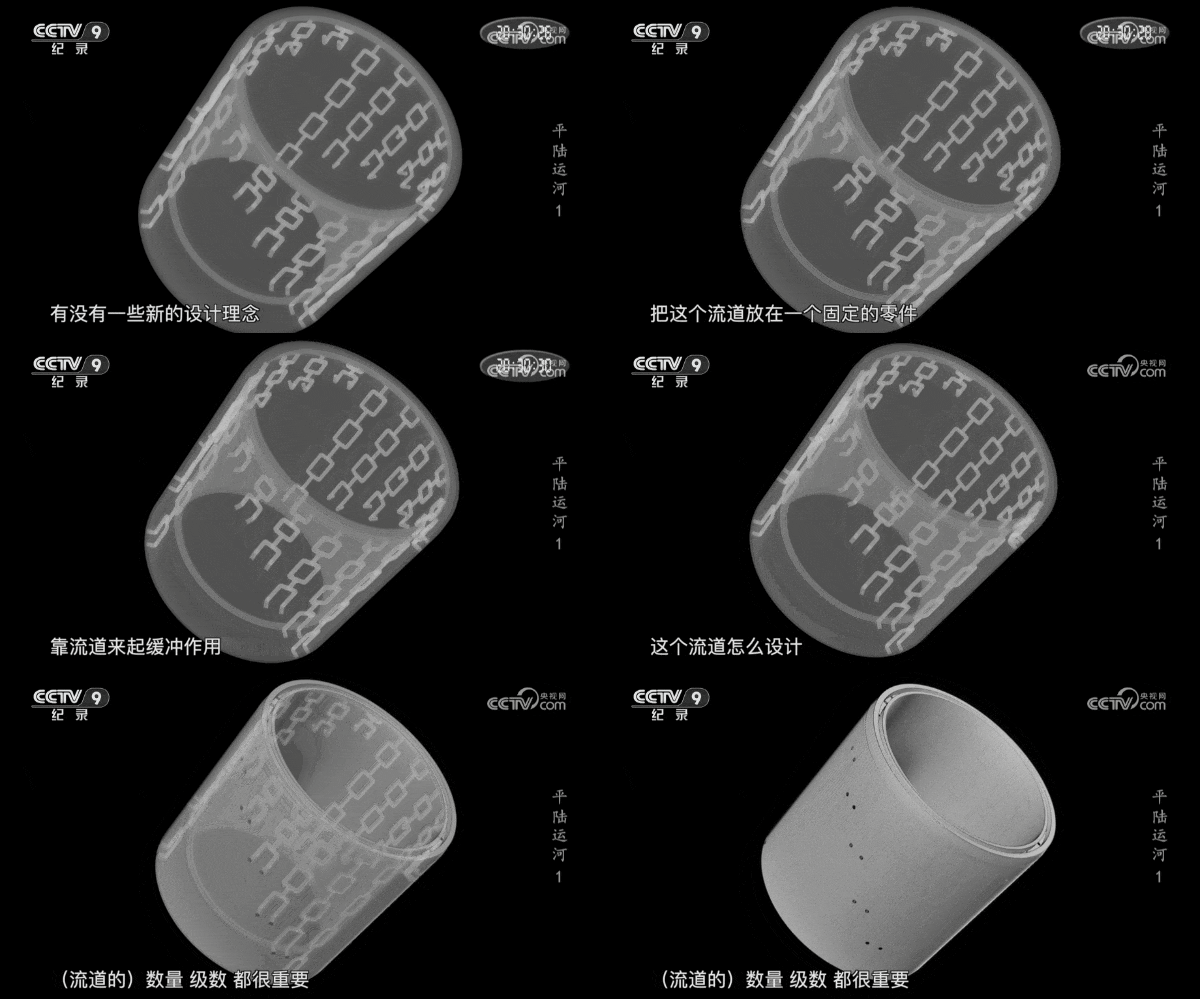
Animation Demonstration from CCTV-9 Documentary "Pinglu Canal"
However, the primary hurdle was the extreme complexity of these flow channels, where both the quantity and number of stages were critical. Conventional casting, forging, welding, and subtractive machining methods all proved unviable.
Metal 3D Printing Resolves the Manufacturing Dilemma
To overcome the ultimate challenge of manufacturing the buffer sleeve with internal labyrinthine flow channels, Professor Chen Yun's team adopted Farsoon's metal 3D printing technology.
According to Farsoon, the company utilized its quad-laser FS350M system to monolithically print two specifications of buffer sleeves, with an overall manufacturing cycle of 165 hours.
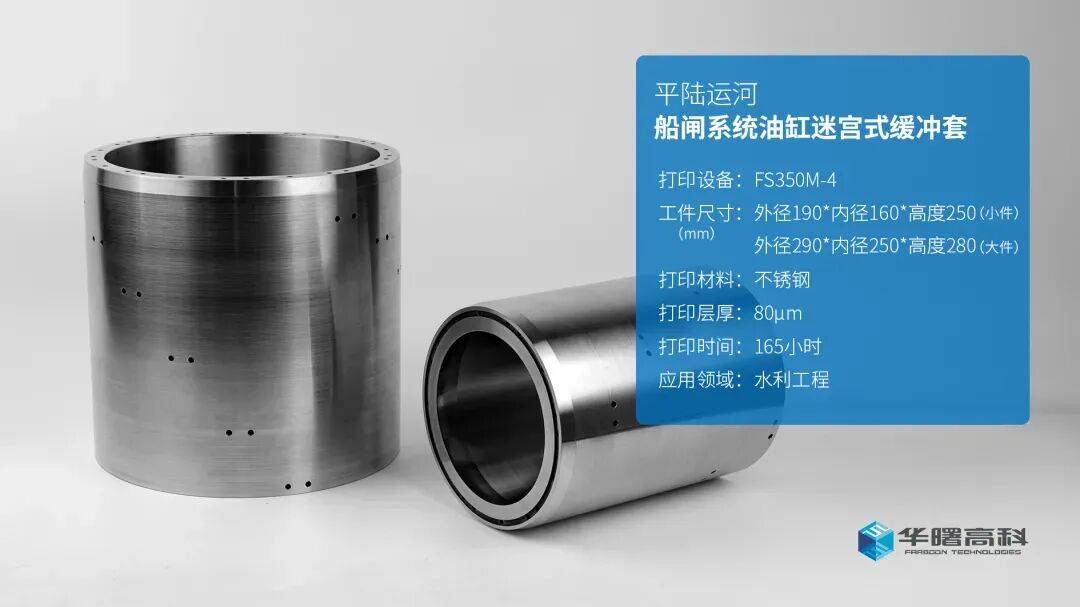
The monolithic product manufactured via additive manufacturing ensured precise formation of complex flow channels without requiring assembly or joining, fundamentally guaranteeing the overall performance of the component.
Such structural geometries are difficult or impossible to fabricate using conventional subtractive methods. The technology enabled the realization of innovative products while significantly shortening the R&D and production cycles of complex core parts, keeping pace with major project construction schedules.
Furthermore, 3D printing drastically reduced assembly complexity. High-precision monolithic printing effectively lowered clearance dependence and eliminated the iterative alignment issues caused by traditional machining and assembly tolerances.

Source: CCTV-9 Documentary "Pinglu Canal"
From Skepticism to Acceptance
3D-printed components must first undergo testing to assess their stability and durability. This serves not only to validate design feasibility but also to evaluate material properties and manufacturing processes. As highlighted in the documentary, this process was not without challenges.
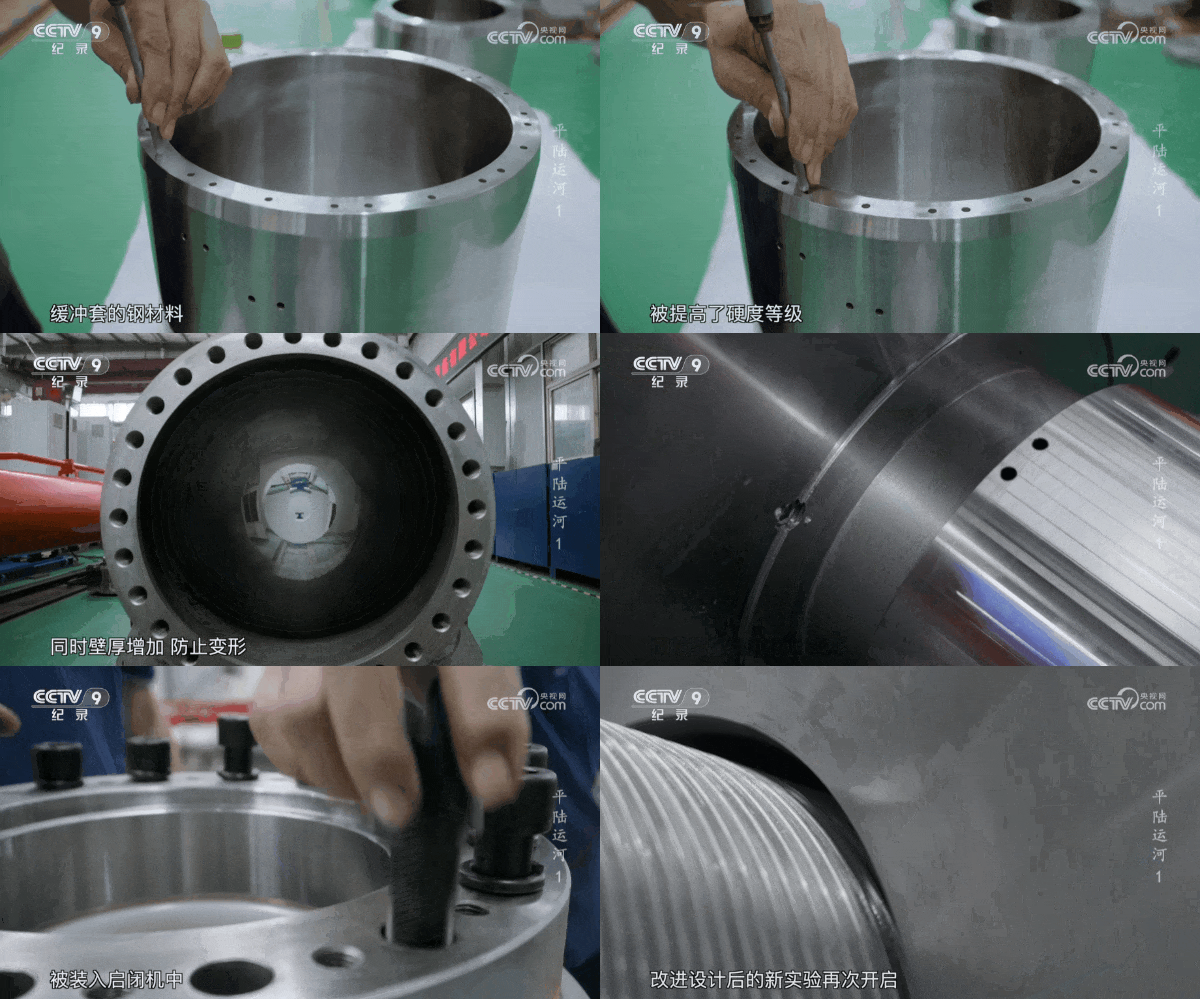
During the initial test, the 3D-printed valve buffer sleeve was mounted on a horizontal test bench and subjected to 1,000 reciprocating cycles. The results revealed severe galling and even deformation on the buffer sleeve surface.

Animation Demonstration from CCTV-9 Documentary "Pinglu Canal"
However, the design team did not doubt the efficacy of the design approach; reverting to conventional manufacturing might have eliminated galling, but it could not resolve the fundamental engineering problem. Ultimately, the steel material for the buffer sleeve was upgraded to a higher hardness grade, and the wall thickness was increased to prevent structural deformation.
Source: CCTV-9 Documentary "Pinglu Canal"
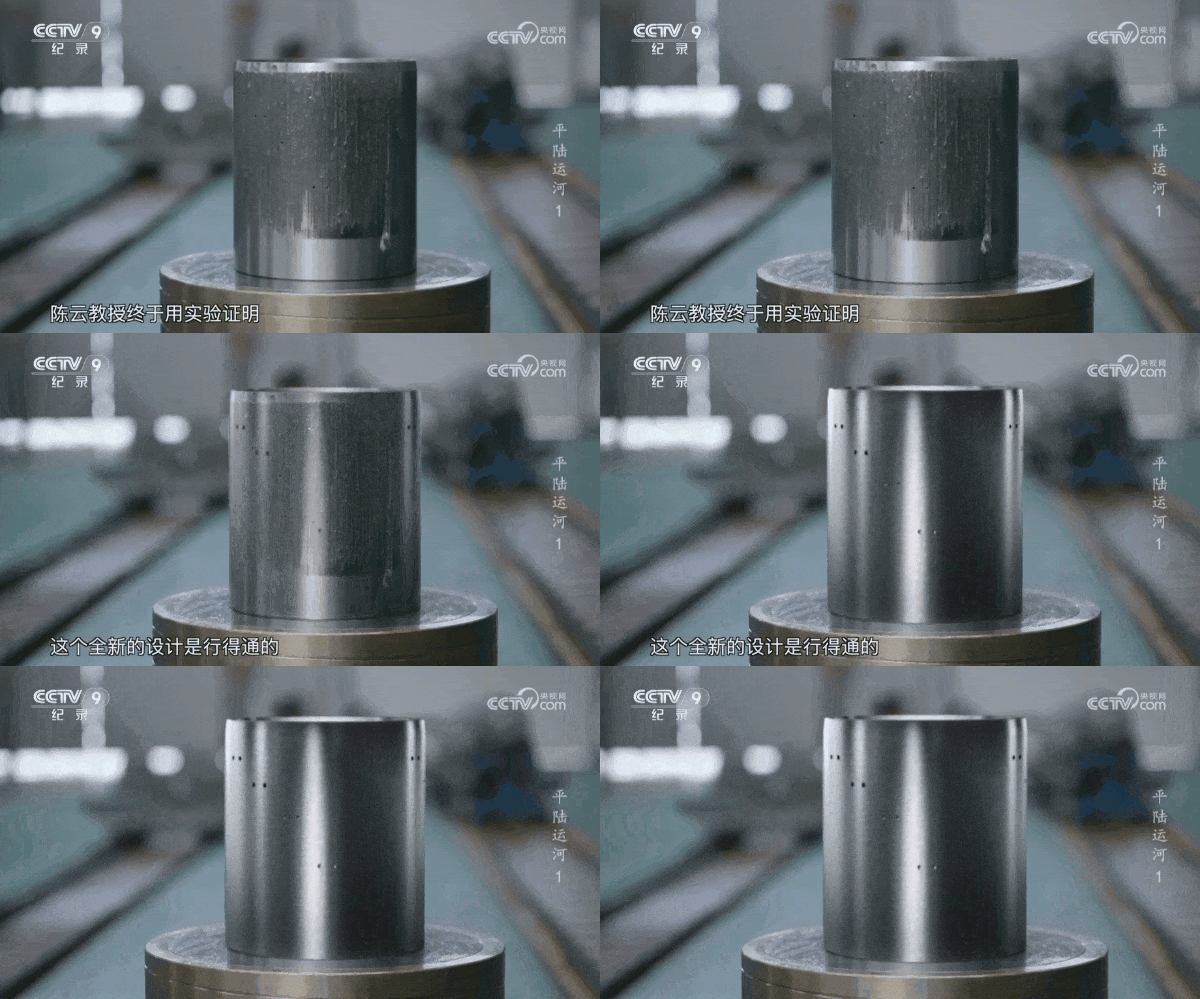
Farsoon rapidly delivered the redesigned components, and testing was resumed. The number of reciprocating cycles was raised to no less than 4,500 over a six-month testing duration. Ultimately, the mating surfaces between the two components remained exceptionally smooth, far exceeding performance expectations.
This demonstrated that the 3D-printed buffer sleeve could function reliably within the hydraulic fast hoist system of the Pinglu Canal lock valves, ensuring long-term operational integrity.
Source: CCTV-9 Documentary "Pinglu Canal"
According to Farsoon, the design solution and complete manufacturing process developed by Professor Chen Yun's team passed acceptance testing in 2025, completely resolving a series of pioneering technical hurdles in the Pinglu Canal lock system.
END
In critical engineering sectors such as aerospace and energy equipment, monolithic manufacturing capabilities for large-scale metal components are making rapid breakthroughs. For complex structures unattainable via conventional processing, 3D printing is emerging as a critical solution.
The successful application of the metal 3D-printed labyrinth buffer sleeve—overcoming initial skepticism—marks not only a key step forward in technological evolution but also strengthens confidence in adopting additive manufacturing across major infrastructure projects.
Note: This article was produced by 3D Printing Reference. Unauthorized reproduction is prohibited. Selected screen captures are sourced from China Media Group's documentary "Pinglu Canal" and are cited solely for technical reporting. #PingluCanal #3DPrinting #Metal3DPrinting